.%20--%3e%3csvg%20xmlns='http://www.w3.org/2000/svg'%20viewBox='0%200%201610%20300'%3e%3cdefs%3e%3clinearGradient%20id='kb'%20x1='0'%20y1='0'%20x2='0'%20y2='300'%20gradientUnits='userSpaceOnUse'%3e%3cstop%20offset='0'%20stop-color='%2373c6e5'/%3e%3cstop%20offset='.25'%20stop-color='%2352b5dc'/%3e%3cstop%20offset='.5'%20stop-color='%233a9fc8'/%3e%3cstop%20offset='.75'%20stop-color='%232b82ae'/%3e%3cstop%20offset='1'%20stop-color='%231a6490'/%3e%3c/linearGradient%3e%3c/defs%3e%3cg%20fill='url(%23kb)'%20fill-rule='evenodd'%3e%3cpath%20d='M0%20300V0H86V136H160V0H246V164H166V219H246V300H160V219H86V300Z'/%3e%3cpath%20d='M401%2083H321V0H567V83H487V219H567V300H321V219H401Z'/%3e%3cpath%20d='M642%20300V0H728V83H808V136H882V0H968V300H882V219H802V164H728V300Z'/%3e%3cpath%20d='M1043%20300V0H1289V164H1209V219H1289V300H1203V219H1129V300ZM1129%2083V136H1203V83Z'/%3e%3cpath%20d='M1364%20300V83H1444V0H1610V300H1524V219H1450V300ZM1450%2083V136H1524V83Z'/%3e%3c/g%3e%3c/svg%3e)
Loads models on demand
Apply deterministic capacity eviction and optional idle unloading across model roles.
Local model operator
Run local models as dependable infrastructure, not a pile of processes.
Paddock manages llama.cpp model lifecycle, OpenAI-compatible routing, downloads, telemetry, and a live operator dashboard on one machine.
Public alpha · Linux x86-64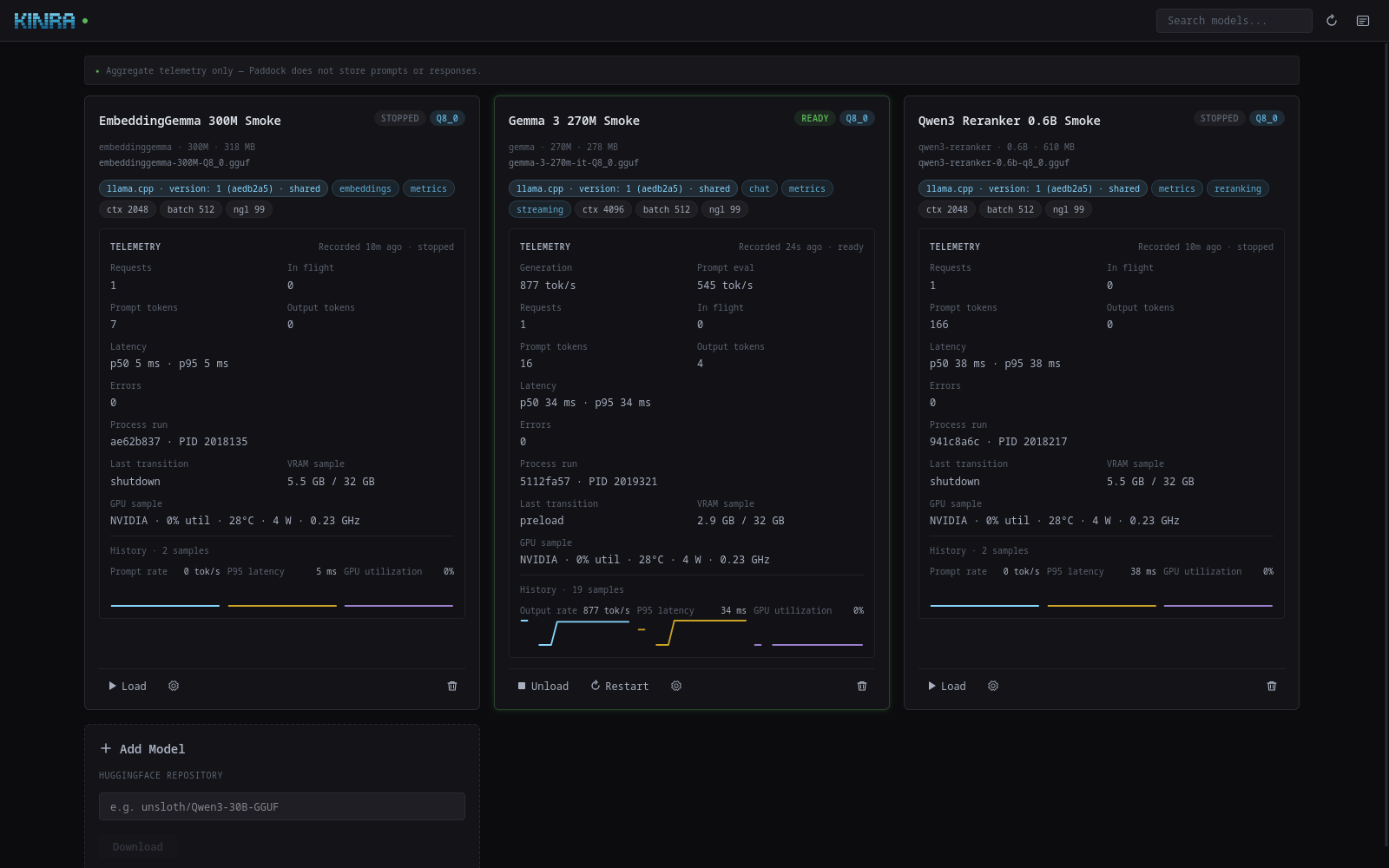
Where it fits
Operators who want a clear, local-first control plane for GGUF models and the applications that depend on them.
Capabilities
Apply deterministic capacity eviction and optional idle unloading across model roles.
Route supported chat, completion, Responses, embedding, and reranking requests through an OpenAI-compatible surface.
Download, validate, register, start, stop, restart, and inspect GGUF model sets.
Watch model, process, request, and GPU behavior without retaining prompts or responses.
Working sequence
Use the public bootstrap and review the current compatibility evidence.
Let Paddock detect the host and build its pinned llama.cpp baseline.
Pull a GGUF artifact set and expose it through the local API when requested.
Boundary
Go deeper